

Last Updated on December 9, 2025 by Jeremy
This article may contain affiliate links. If you click through and make a booking or purchase, we may earn a commission at no extra cost to you. It helps us keep creating free travel resources.
Painted turtles live in slow moving freshwater habitats across much of North America, from southern Canada through the United States and into northern Mexico. They prefer shallow ponds, marshes, lakes, and quiet rivers with soft, muddy bottoms and plenty of basking spots.
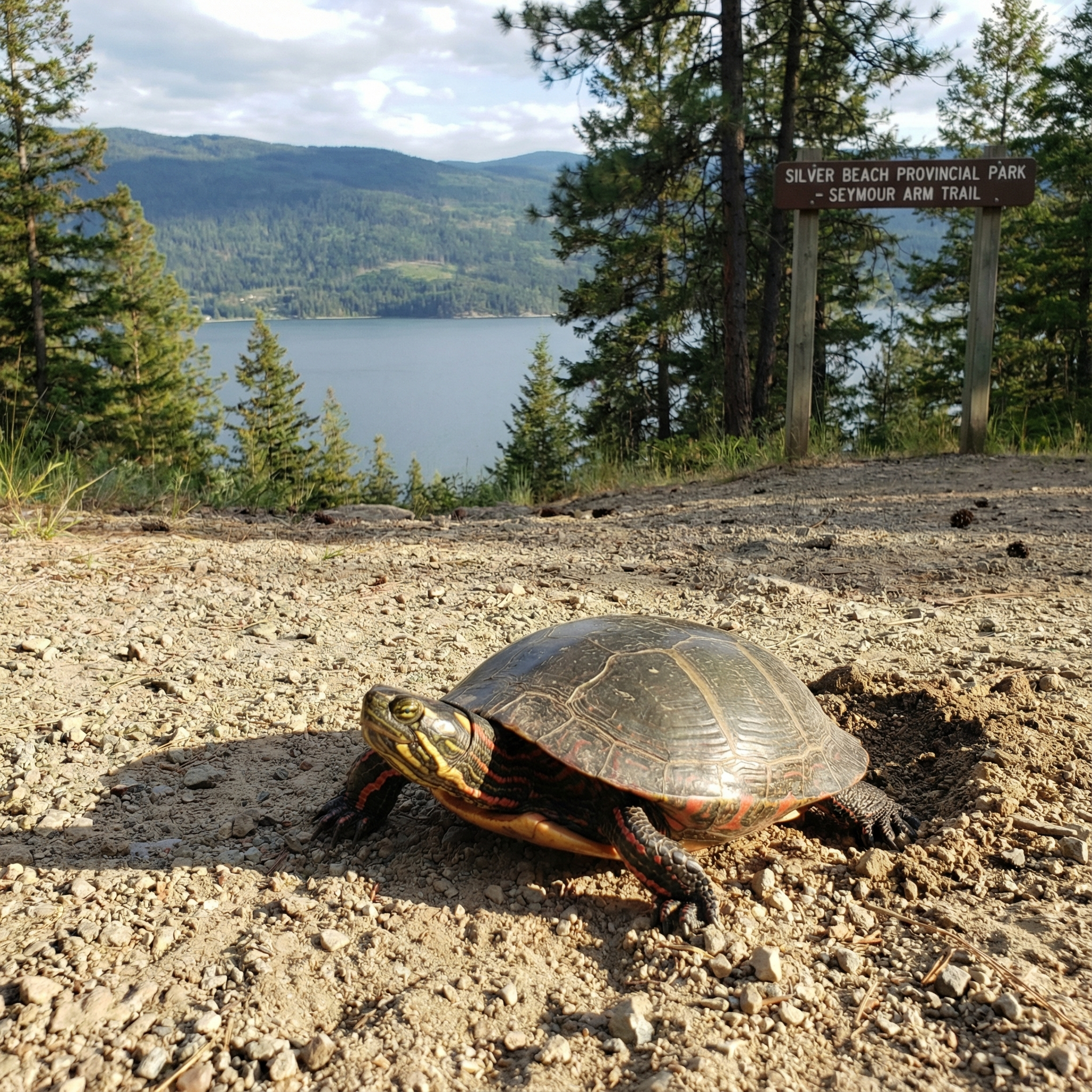
A painted turtle moment in the Shuswap
I grew up thinking turtles belonged in warm places, not in the colder lakes and forests of Canada. That belief disappeared the day we were operating a provincial park in Seymour Arm, along the remote shoreline of Shuswap Lake.
One afternoon, while walking a trail about a hundred feet from the water, I spotted a Western Painted Turtle digging a nest right in the packed dirt of the path. She worked in slow, steady motions. First she carved out a shallow cavity with her hind legs, then carefully dropped her eggs, pausing between each one. When she finished, she pushed the soil back into place, tamped it down, and slipped quietly toward the lake.
My daughter, who loves reptiles, abandoned whatever she was doing the moment she saw what was happening. She watched from a respectful distance, completely locked in. Moments like that stay with you and change how you look at familiar landscapes.
That encounter raised the same questions many travelers eventually ask. Where do painted turtles actually live, how do they handle Canadian winters, and where do you go if you want to see them in the wild instead of by accident on a trail.
Where do painted turtles live
Painted turtles are one of the most widespread freshwater turtles in North America. They are comfortable in calm, plant rich water and show up in more places than most people realize.
Typical habitats include:
- Small ponds and marshes
- Shallow lakes with weedy shorelines
- Slow moving creeks and rivers
- Wetlands with soft, muddy bottoms
They look for quiet water with aquatic plants, submerged logs, and sunny spots where they can climb out and bask. Their overall range stretches from southern Canada, across most of the United States, and down into northern Mexico.
Subspecies and regional ranges
Several subspecies of painted turtle share similar habits but live in different regions. Knowing which one you are likely to see can help when you plan trips.
-
Western Painted Turtle (Chrysemys picta bellii)
Found in British Columbia, Alberta, Saskatchewan, Manitoba, and down into the western United States. This is the one you are most likely to spot in prairie ponds and many western lakes. -
Midland Painted Turtle (Chrysemys picta marginata)
Common in the Great Lakes region, including Ontario, Quebec, Michigan, New York, and nearby states. -
Eastern Painted Turtle (Chrysemys picta picta)
Found through parts of the eastern United States, such as Virginia and the Carolinas, and in parts of Nova Scotia and New Brunswick. -
Southern Painted Turtle (Chrysemys picta dorsalis)
The smallest subspecies, found mostly in the southern United States, including areas of Texas and Louisiana, and extending into parts of Mexico.
With such a broad range, your odds of spotting painted turtles are good anytime you spend slow, quiet time near warm, shallow water.

How painted turtles survive cold climates
One of the most surprising things about painted turtles is how far north they live. In many Canadian lakes they survive long winters under ice, in conditions that would kill many other reptiles.
They manage this by:
- Slowing their metabolism dramatically in cold water
- Settling into the soft bottom or sheltering in underwater burrows
- Absorbing small amounts of oxygen through the lining of their throat and cloaca
For much of the winter they barely move at all. When spring arrives and the ice melts, they surface, climb onto logs, and start basking in the sun to warm up and restart their systems.
In some populations, nest temperature influences whether more males or females hatch. Warmer nests produce more females, cooler nests more males. It is a small detail with big implications, and it shows how sensitive these animals are to habitat and climate changes.
Top places to see painted turtles in the wild
If you want to turn painted turtle watching into an actual trip, these regions and parks are a strong starting point. You can pair turtle spotting with paddling, hiking, camping, or wildlife photography.
1. Point Pelee National Park, Ontario, Canada
Point Pelee combines marshes, ponds, and boardwalks, which makes it a reliable place to see painted turtles in spring and summer. The calm, shallow water and sunny log jams are ideal turtle habitat.
Explore the marsh boardwalk on foot or rent a canoe or kayak. Move slowly and scan logs, rocks, and edges of the cattails. Many turtles slip into the water if approached too quickly, so patience matters more than distance covered.
2. Everglades National Park, Florida, United States
The Everglades are one of the most famous wetlands on the planet. They host a mix of turtles, alligators, and a long list of wading birds. Painted turtles share slow moving channels and pools with many other species.
The safest and most informative way to explore is with a guided airboat or boat tour. Experienced guides know how to keep a respectful distance from wildlife while still giving you a clear view.
For a classic Everglades experience, you can look at an option such as: Everglades Airboat Safari Adventure with Transportation .
3. Algonquin Provincial Park, Ontario, Canada
Algonquin is one of Canada’s classic backcountry destinations. Lakes, rivers, and wetlands spread through the park, and painted turtles are only one of many species you can see if you travel at a relaxed pace.
Canoe routes are the best way to see turtles here. Early morning and late afternoon are particularly good times to spot them basking. On calm days you can often paddle fairly close without disturbing them, as long as you move quietly.
4. Great Smoky Mountains National Park, Tennessee and North Carolina, United States

The Smokies are famous for scenic ridges and crowded viewpoints, but quieter corners of the park hold ponds, slow streams, and roadside wetlands where painted turtles live.
You can combine short hikes with time spent near low gradient streams and marshes. A basic pair of binoculars or a camera with a modest zoom lets you watch turtles without walking straight up to them.
5. Wetlands of Baja California and northern Mexico
At the southern edge of their range, painted turtles live alongside a different cast of birds and aquatic species. Warm weather allows for long seasons of basking and feeding.
Look for coastal lagoons, inland wetlands, and mangrove lined waterways. Kayak tours are a good way to move quietly through these habitats while keeping your impact light.
Explore nature and wetland tours
If you enjoy the idea of combining wetland paddles, wildlife viewing, and quiet photography, you can start by browsing a curated list of nature focused tours from trusted operators.
What do painted turtles eat
Painted turtles are omnivores, and their diet shifts as they grow. Young turtles tend to chase more protein, while adults eat a mix of plants and smaller animals.
- Young turtles focus on insects, small crustaceans, tadpoles, and small fish when they can catch them.
- Adults add more aquatic plants, algae, and water lilies to the menu, along with whatever small animals they can reasonably handle.
- Basking in the sun helps them regulate body temperature and digest food more efficiently.
In captivity, a healthy painted turtle diet needs to mimic this variety as closely as possible, with a mix of quality turtle pellets, leafy greens, and occasional protein, along with proper lighting and clean water. For most people, painted turtles are better appreciated in the wild than in a tank.

Gear for turtle watching and wildlife photography
You do not need high end equipment to enjoy painted turtles, but a few simple pieces of gear can make the experience better for you and less stressful for the animals.
- A lightweight pair of waterproof or water resistant binoculars so you can watch from a distance instead of creeping up to the shoreline.
- A camera with a modest zoom lens if you want to capture basking turtles without pushing them off their logs.
- Footwear that can handle wet, muddy ground around ponds, marshes, and lake edges.
- A small kayak or canoe, or a guided paddle trip, if you want to explore quiet backwaters and sheltered bays.
A simple rule of thumb applies. If your presence makes turtles slide off their log every time you approach, you are too close. The best encounters happen when they barely react to you at all.
Final thoughts
Painted turtles are far more widespread than most people realize. They show up in roadside ponds, national parks, prairie sloughs, and southern wetlands. Once you know what to look for, you start seeing them everywhere.
If your idea of a good trip includes quiet water, bird calls, and a chance to spot wildlife without crowds, painted turtles fit right in. A calm morning paddle or a slow walk along a marsh boardwalk is often all you need.
Next time you are near a pond, lake, or wetland, scan the logs and rocks along the edges. That little bump in the sun might be a painted turtle watching you right back.
Frequently asked questions about painted turtles
Where do painted turtles live in North America
Painted turtles live in slow moving freshwater habitats across much of North America, including southern Canada, most of the United States, and parts of northern Mexico.
Can you find painted turtles in Canada
Yes. Painted turtles are found in several Canadian provinces, including British Columbia, Alberta, Saskatchewan, Manitoba, Ontario, Quebec, Nova Scotia, and New Brunswick, usually in calm, plant rich water.
What type of habitat do painted turtles prefer
They prefer shallow ponds, marshes, lakes, and slow moving rivers with soft, muddy bottoms, aquatic vegetation, and plenty of sunny basking spots like logs and rocks near the surface.
How do painted turtles survive winter in cold climates
In cold regions, painted turtles slow their metabolism, settle into the mud or underwater shelters, and absorb limited oxygen through the lining of their throat and cloaca while ice covers the surface above them.
What do painted turtles eat in the wild
Painted turtles are omnivores. Young turtles focus on insects, small fish, and other animal prey, while adults eat more aquatic plants, algae, and water lilies along with smaller animals when available.
How can I watch or photograph painted turtles without disturbing them
Use binoculars or a zoom lens, move slowly, and keep enough distance that the turtles stay relaxed and continue basking. If they repeatedly slide into the water as you approach, you are too close and should back off.




Leave a Reply