
Last Updated on November 7, 2026 by Jeremy
Planning guide reviewed November 7, 2026. This guide compares trip structures; it is not a quote or availability check.
Seven days in Costa Rica sounds generous until you count how many of them go to checkouts, transfers and unpacking. The question that shapes a relaxed week is not how many sights you can fit in. It is how many times you will move your luggage. For a seven-day Costa Rica trip, choosing one base or two is a practical decision about how you want the week to feel.
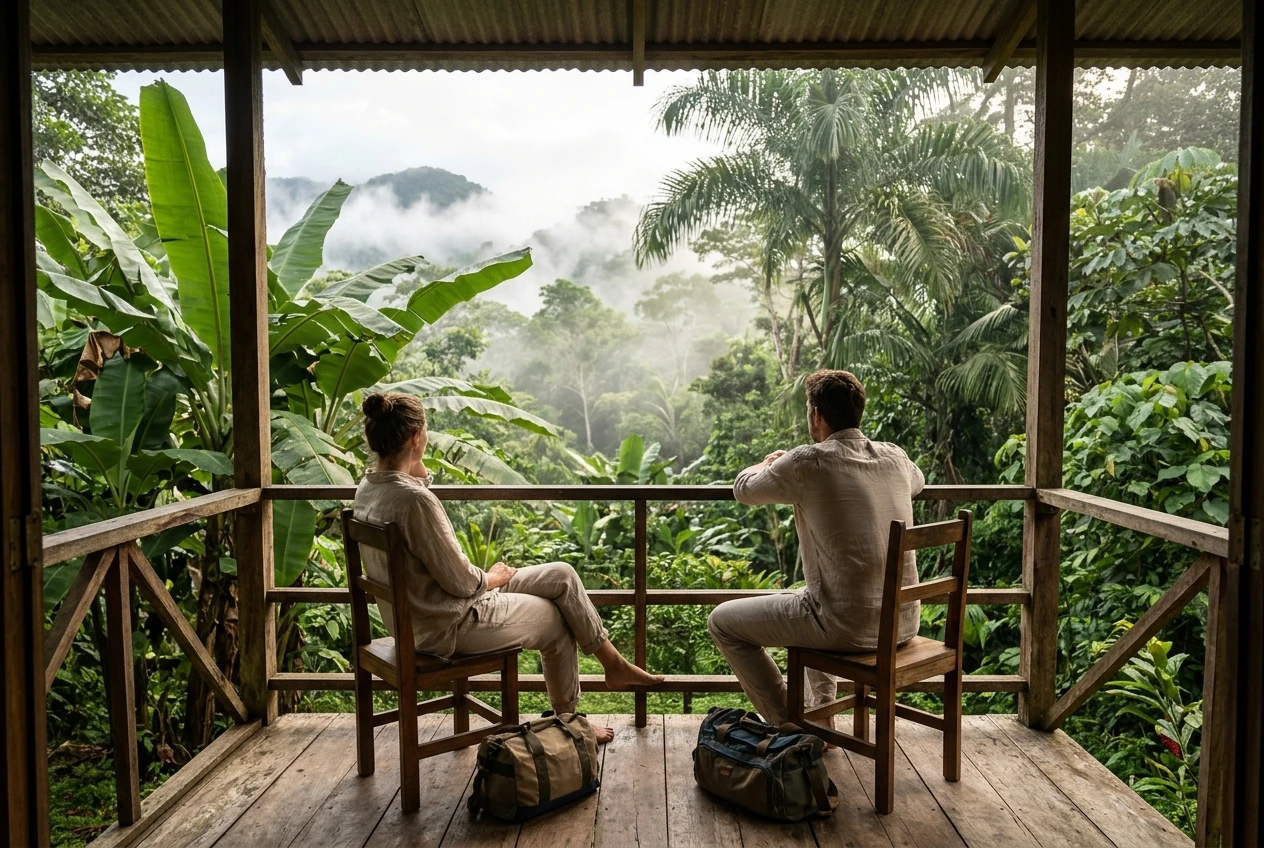
Image: AI-created editorial illustration of an unhurried tropical lodge stay, not a photograph of a particular property.
A note on sourcing: this is researched planning information, not a trip report. It contains no personal visit stories, prices or drive times. Check those for your exact dates before you book anything.
Why the number of bases matters more than the number of attractions
An attraction is something you choose. A base is something you live in, and it decides which attractions are within easy reach on any given morning. Every extra base takes a slice out of a short trip: the morning you pack, the transfer, the afternoon you check in and look for dinner.
Over a long holiday that cost barely registers. Over six nights it adds up quickly, because each move can eat most of a day. Your tolerance for moving matters more than the number of people travelling. A couple who wants quiet mornings may prefer one base just as much as a family managing tired children.
So start with the bases and fit the attractions around them. The reverse tends to produce the packed route most first-timers say they want to avoid.
What each hotel change really costs a 7-day trip
A hotel change costs more than the booking itself:
- Time: checkout comes before check-in, so a move day is only partly usable even when the trip itself is short.
- Transport: you will need a private transfer, a shuttle or a rental car, and each of those has its own cost and booking effort.
- Energy: repacking, re-orienting and learning a new neighbourhood is tiring, especially with children.
- Flexibility: the more fixed hotel dates you have, the harder it is to shuffle a day when the weather or your mood changes.
Here is the counting rule that keeps this honest. Count hotel stays, not destinations. If you spend your first night near the airport and then move to one destination, that is two hotel stays, even though you would describe the trip as “one base.” The gateway night is a real night in a real room, and it belongs in your plan from the start.
Drive and transfer times vary with route, traffic and conditions, so check them with your transfer provider or a current map for your actual dates instead of trusting a number from an article.
Check your flights first: airport fit and late arrivals
Do this before you look at a single hotel. Costa Rica’s two main international gateways are San José (SJO) and Liberia (LIR), and which one your flight uses changes what the first and last nights should look like.
Look up the exact arrival and departure times, then ask three questions:
- When do you land, and when will you actually be out of the airport? After immigration and baggage, a late evening landing leaves little room for a long onward journey.
- Is it sensible to travel after dark? If your destination involves a long or unfamiliar road, a night near the airport and a daylight transfer in the morning is usually the calmer choice. Check sunset time for your travel dates and plan transfers to finish before then.
- When does your flight home leave? An early departure may mean spending the last night near the airport too.
If both ends need a gateway night, that is two of your six nights. That leaves four for everything else, which makes a single destination base the more comfortable choice.
Six nights, one gateway night plus five at a single destination
This is the simplest structure: one night near the airport, then five nights in one place.
- Hotel stays: 2
- Moves between hotels: 1 (plus the airport transfers at either end)
It suits families, anyone who likes to unpack once, and travellers drawn to one specific kind of trip: a single nature region, a beach stay, or a focus such as rivers and fishing. If that last one sounds like you, our guide to fly fishing in Costa Rica, with rivers, seasons, guided trips and lodge stays is a good example of how a single-focus week can be built around one area.
If your flights let you land early and leave late, you might not need the gateway night at the front at all. In that case you have six nights at one destination and only one hotel stay. Whether that works comes down to the flight times, not to preference.
Two destination bases plus a gateway: three hotel stays within six nights
The two-base version looks like this: one gateway night, three nights in a nature-focused area, and two nights at the beach.
- Hotel stays: 3
- Travel days: the move from the gateway to the first base, the move to the second base, and the trip to the airport at the end
That is three travel days in a seven-day trip. It can still be relaxed, but only if three conditions hold:
- Your exact flights fit. The arrival time must allow a sensible gateway night, and the departure must not force a rushed final morning.
- The departure transfer is sorted. The beach base needs a realistic route to the airport for your flight time, so confirm it before you pay for the stay.
- Travel happens in daylight. If a move would run past dusk, change the order or drop the second base.
If one of these fails, go back to a single destination. Two bases with no breathing room are more tiring than one base with a quiet afternoon.
A split like this also needs enough time in each place. Two nights somewhere is short: you arrive, you have one full day, and you leave. Three nights gives you a day to explore and one to do nothing, which is often where a relaxed trip actually happens.
Free days, day trips and what one base can’t stretch to
Whichever structure you choose, keep a free day, or at least a free afternoon. Plan one main activity per day and leave the rest open. A one-base week leaves room to ask about rescheduling a weather-affected activity. Availability and cancellation terms still apply, so do not assume a booking can be moved for free.
Day trips from a single base are a good way to see more without moving your bags. Which excursions are available depends on the area and the operators there, so confirm what is offered and how long it runs before you count on it. Our list of bucket-list experiences you can afford in Costa Rica can help you pick one or two worth building a day around.
What one base cannot do is cover regions that sit far apart. If your wish list includes a cloud-forest morning and a Pacific beach afternoon and a river trip, that is a conversation about a longer stay or a second base, not about squeezing in a longer drive. If you are unsure which regions pair well, our curated travel page is the place to ask for planning help.
Climate varies by region: what the official tourism board says to check
Costa Rica’s weather differs by region, so a single national forecast tells you little about where you will actually be staying. Visit Costa Rica, the official tourism board, publishes regional climate information and travel tips, and both are worth reading for the specific regions and month you are considering before you lock in a base.
Use that information in two ways:
- Choose bases with your month in mind. A region that suits one time of year may be less comfortable in another, so check before assuming a beach or a forest will look the way a photo does.
- Match structure to uncertainty. If conditions in your month are changeable, a single base makes it easier to swap a day trip to a better morning. A two-base plan has fixed move days that are harder to shift.
The official tips pages also cover practical points for visitors, so read them alongside this guide rather than treating any one article, including this one, as the final word.
One base, two bases or a longer trip: a quick way to decide
| Structure | Hotel stays | Best fit |
|---|---|---|
| 1 gateway night + 5 at one destination | 2 | One main focus and more downtime |
| 1 gateway + 3 nature + 2 beach | 3 | Flights and transfers fit without a rushed departure |
| 6 nights at one destination | 1 | Flight times allow direct arrival and departure transfers |
Work through it in this order:
- Confirm your arrival and departure times.
- Decide whether you need a gateway night at either end.
- Count your hotel stays, gateway included.
- If the count is one or two, check that the day-trip radius and airport connections fit. If it is three, check every move day and the departure transfer before committing.
- If you want more than three stays, the week is too short for that plan. Add nights instead of squeezing in more bases.
A longer trip does not have to mean more moves. Extra nights are often better spent lengthening a stay you already like than adding a new one.
Ready to look at your own version?
If you are at the stage of weighing options, Build My Trip Preview is the place to start. Tell us your destination interests and preferences, and you get early, preliminary guidance. It is not an itinerary, a quote or a guarantee of availability, so treat it as a way to test your one-base or two-base idea before you commit.
If you already know your structure and want to look at stays and transfers, you can open our booking tools. Some of the tools there may use affiliate links, which means Earthbound Tours may earn a commission if you book through them. Check current availability and terms on the provider’s site before you pay.
Leave a Reply