
Last Updated on August 24, 2026 by Jeremy
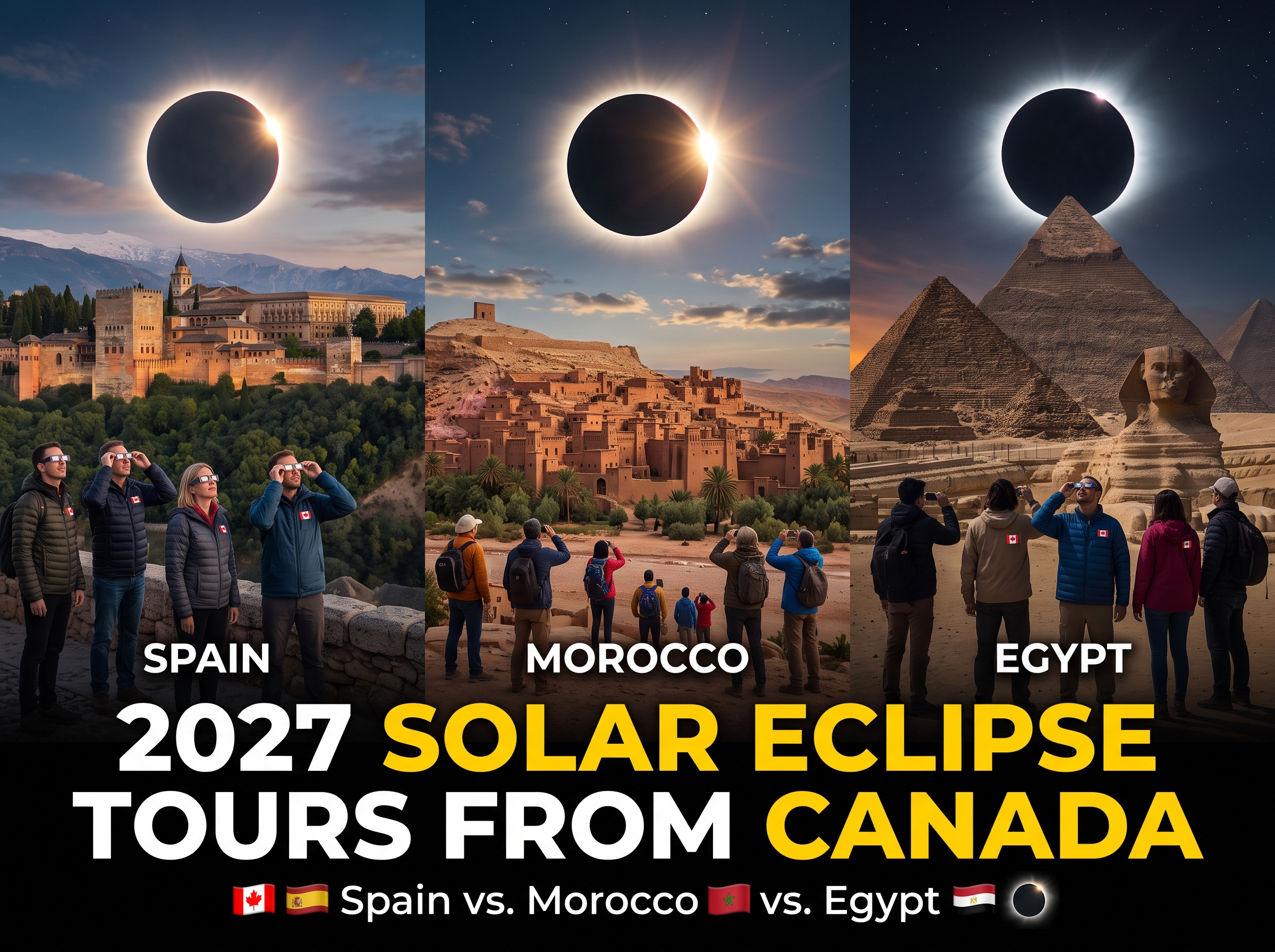
The hard part of planning for the August 2, 2027 total solar eclipse is not deciding whether it will be spectacular. It is choosing between three very different trips before the best-positioned rooms, transfers and organized viewing sites become difficult to piece together.
Spain is the easiest trip to organize, northern Morocco offers nearly five minutes of totality with a distinctive cultural itinerary, and Egypt delivers the longest eclipse of the three. The right choice depends on how much heat, logistical complexity and travel uncertainty you are comfortable accepting for extra time in the Moon’s shadow.
Quick answer: Choose southern Spain for the simplest first eclipse trip, Tangier or Tétouan for a strong balance of totality and cultural travel, or Luxor for an eclipse-first journey built around approximately six minutes and 22 seconds of totality.
Exact eclipse duration depends on the coordinates of your viewing site. A destination name alone does not confirm that a hotel or tour is inside the path of totality.
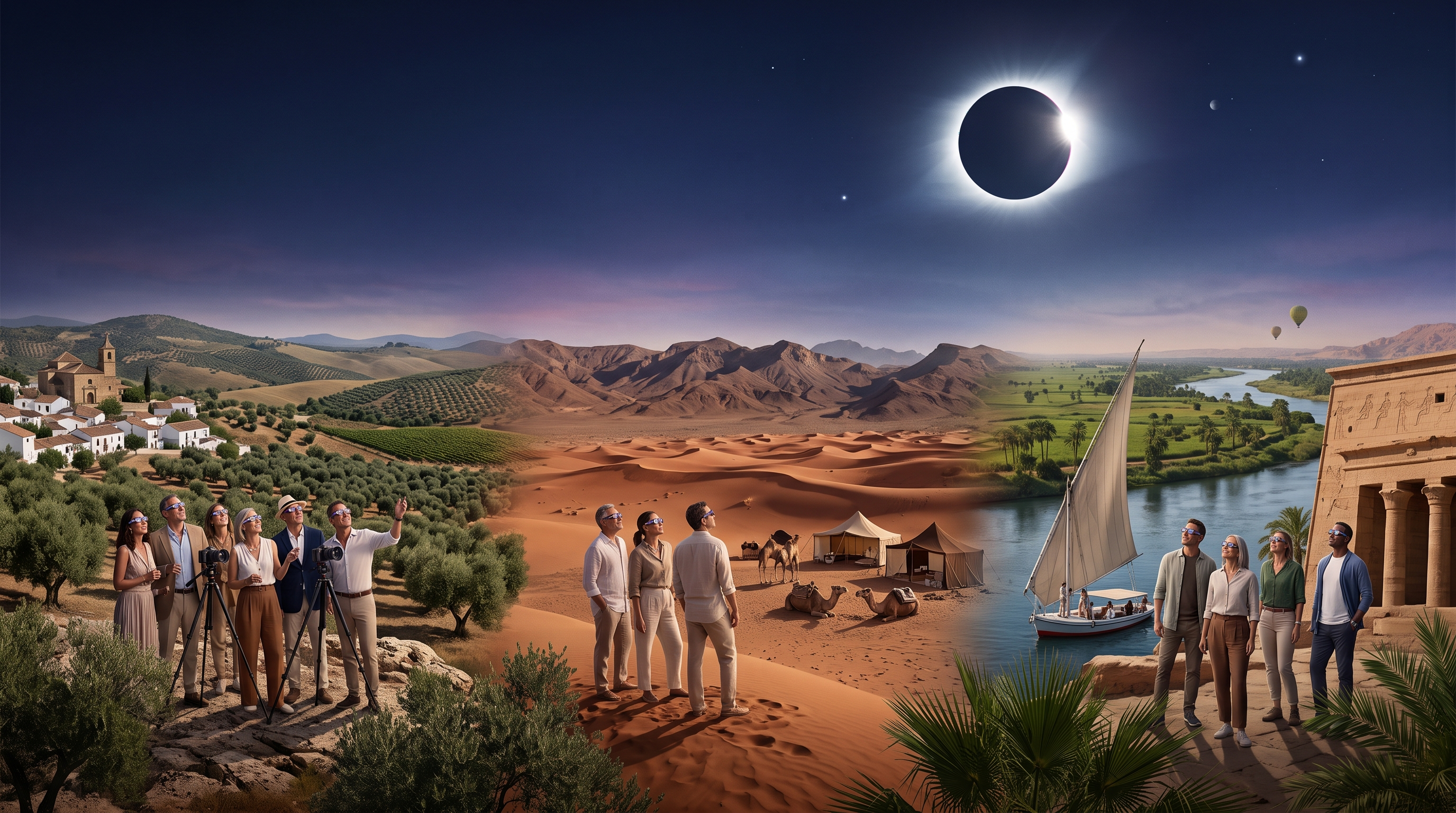
This image was created with AI for illustrative purposes.
What Makes the August 2, 2027 Eclipse Different?
NASA lists the event as a total solar eclipse crossing southern Europe, North Africa and parts of the Middle East. The maximum duration near the centre of the path will be approximately six minutes and 23 seconds, making this an unusually long total eclipse.
Totality is visible only from within a narrow moving shadow. Travellers outside that path will see a partial eclipse, which is a different experience: the sky does not reach the same sudden darkness, and the solar corona is not revealed in the same way.
Canada is not a totality destination for this event. The Canadian angle is therefore about choosing and booking a trip from Canada—not watching the total phase from home.
| Destination | Approximate totality | Strongest reason to choose it | Main planning friction |
|---|---|---|---|
| Southern Spain | About 1:48 in Málaga to 4:48 in Ceuta | Familiar infrastructure and an easy European trip extension | Narrow path, August crowds and location-sensitive duration |
| Northern Morocco | About 4:51 around Tangier | Long totality with a culturally rich North African itinerary | Morning coastal cloud and more transfer planning |
| Luxor, Egypt | About 6:22–6:23 near Luxor | The longest totality of these three choices | Extreme August heat and greater logistical complexity |
Spain: The Most Straightforward First Eclipse Trip
Spain is the easiest of the three options to fold into a familiar European vacation, but travellers still have to choose carefully. Spain’s official Instituto Geográfico Nacional says the totality path crosses the extreme south, including much of Cádiz, part of Málaga, southern portions of Granada and Almería, plus Ceuta and Melilla.
The difference between locations is meaningful. Official examples put totality at roughly two minutes 54 seconds in Cádiz, one minute 48 seconds in Málaga, four minutes 34 seconds in Melilla and four minutes 48 seconds in Ceuta. A convenient hotel in a famous city can therefore trade away several minutes of totality.
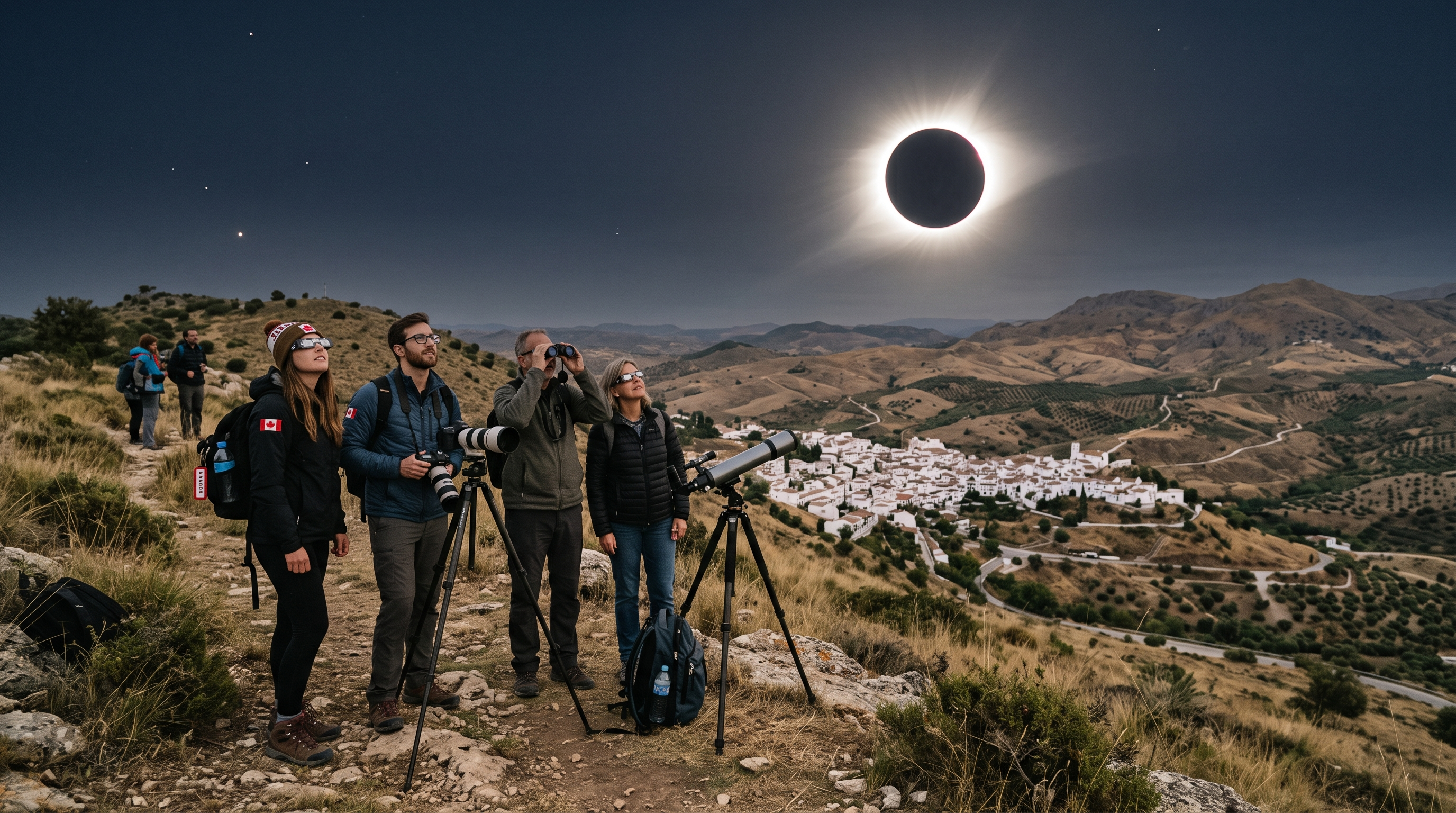
This image was created with AI for illustrative purposes.
August is also peak travel season. Expect pressure on accommodation, rental vehicles and roads leading to organized viewing areas. Spain’s official eclipse weather guidance indicates generally low cloud probability in the southern path, although western Cádiz can be more exposed to humid Atlantic air.
Spain is best for: first-time eclipse travellers, families, and people who want the eclipse to anchor a wider Spain or Portugal itinerary without making every day of the trip about astronomy.
Morocco: Nearly Five Minutes With a Different Kind of Journey
The Moroccan path to focus on is in the north around Tangier and Tétouan. It is not centred on Marrakech or the Sahara, even though desert images are often used to market eclipse travel. Tangier receives approximately four minutes and 51 seconds of totality, giving it a longer total phase than most mainland Spanish bases.
The eclipse happens in the morning, so coastal cloud and low marine layers deserve attention. A responsible operator should explain why its viewing site was chosen, what transportation is included and whether it has any flexibility if local conditions differ from expectations.
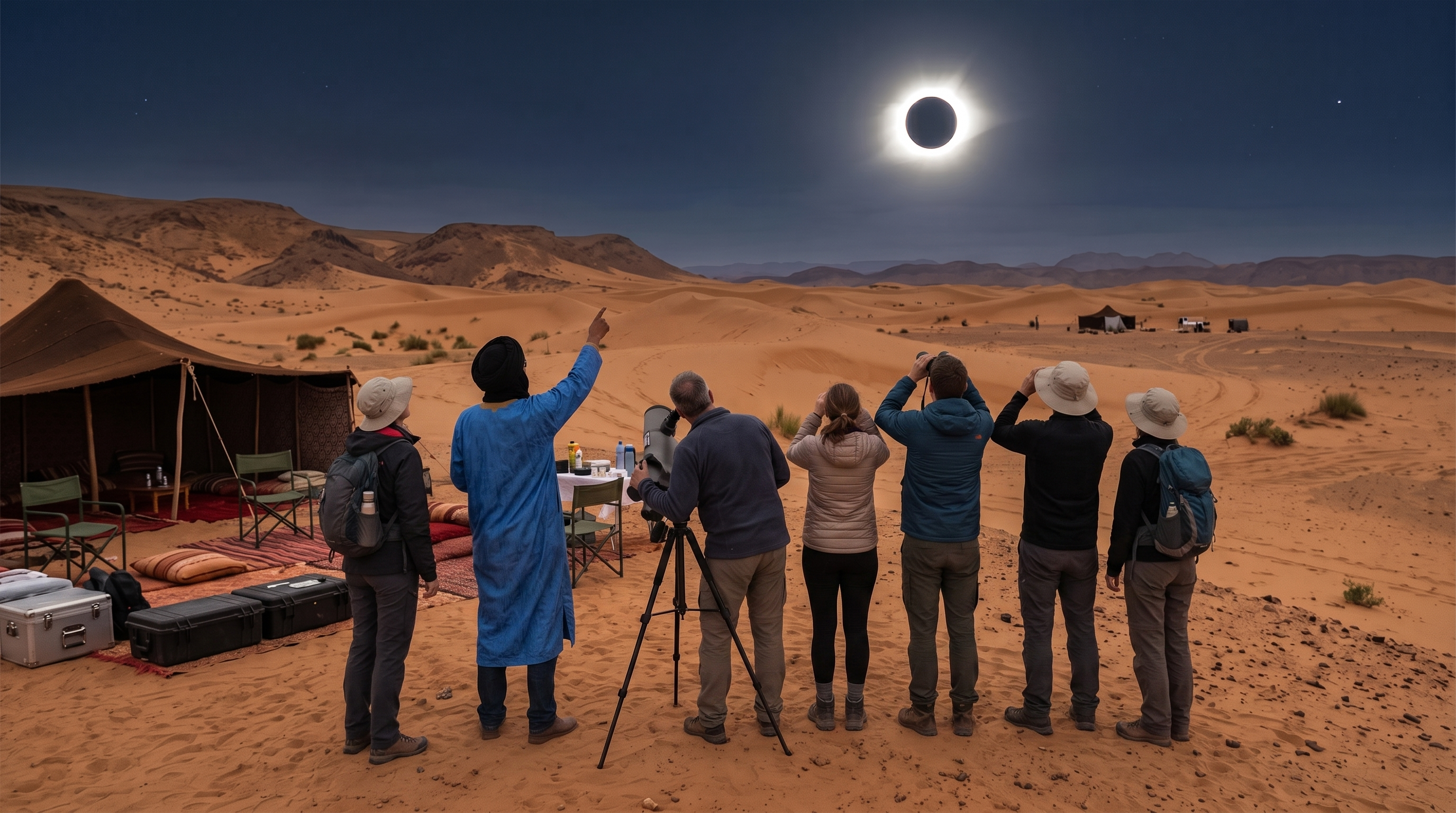
This AI-created image is illustrative. The Moroccan totality locations discussed in this guide are around Tangier and northern Morocco, not the Sahara.
Morocco works especially well when the itinerary continues beyond eclipse morning. Tangier, Chefchaouen, Tétouan, Fez or a longer southbound journey can turn a fixed astronomical event into a broader cultural trip.
Morocco is best for: travellers who want close to five minutes of totality, are comfortable with more active trip planning and want the destination itself to feel substantially different from a standard European vacation.
Planning checkpoint: Before paying a non-refundable deposit, ask for the proposed viewing coordinates—not just the nearest city—and confirm whether transport to the site is included.
Egypt: The Eclipse-First Choice
Luxor sits close to the longest-duration portion of the path. Travellers positioned near the centreline can receive approximately six minutes and 22 seconds of totality, with the global maximum reaching roughly six minutes and 23 seconds.
That extra time comes with a serious tradeoff: Luxor in August is extremely hot. A competent eclipse plan needs more than a clear field. It should include shade, drinking water, washrooms, medical awareness, controlled transport and enough time to arrive before traffic restrictions or crowding affect access.
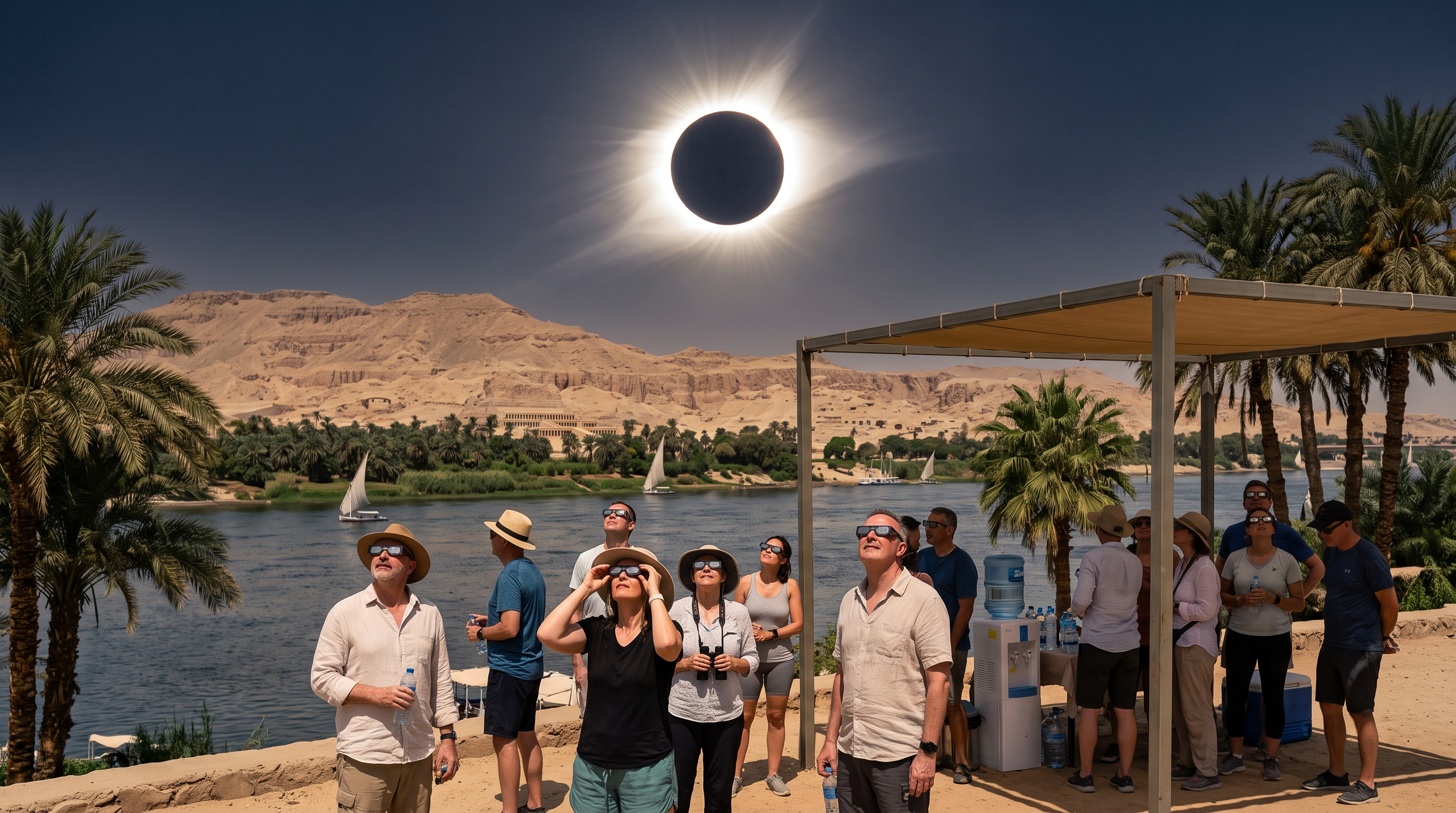
This image was created with AI for illustrative purposes.
Egypt also requires the greatest attention to changing travel conditions. Canadian travellers should review the Government of Canada advisory when choosing a package, again before final payment and immediately before departure. A status shown in 2026 cannot be treated as a prediction for August 2027.
Egypt is best for: experienced travellers and dedicated eclipse chasers who value maximum totality enough to accept heat, a more structured itinerary and additional planning checks.
How to Choose a Tour From Canada
There are three sensible ways to organize this trip. A DIY traveller can book flights, accommodation and local experiences separately. A guided-tour traveller can select an astronomy-focused departure with a controlled viewing site. A curated itinerary can combine either approach with help coordinating flights, pre-eclipse stays and post-eclipse travel.
What a Real Eclipse Package Should Confirm
- The viewing site is inside the path of totality, with coordinates available.
- An astronomer, trained eclipse leader or clearly documented safety briefing is included.
- Transportation arrives well before local road closures and crowd pressure.
- The site has an unobstructed solar view plus shade, water and washrooms.
- Safe solar viewers are supplied or their specifications are stated.
- The weather, backup-site and cancellation policies are written clearly.
- The deposit schedule and non-refundable portions are understood before payment.
Special eclipse inventory changes quickly, so Earthbound should not label a general destination tour as an eclipse package unless the operator explicitly includes the August 2 event. For surrounding activities, travellers can browse Viator experiences or GetYourGuide activities, then compare nearby stays through Booking.com.
Build the Eclipse Trip Around the Viewing Site
Start with the country and exact totality location. Flights, stays, transfers and sightseeing can then be arranged around the one appointment that cannot move.
Flight schedules, tour inventory, entry requirements and travel advisories can change before August 2027.
Solar Eclipse Safety Is Not Optional
NASA advises that ordinary sunglasses are not safe for looking at the Sun. During every partial phase, use solar viewers that comply with the ISO 12312-2 standard, or use an indirect viewing method such as a pinhole projector.
Cameras, telescopes and binoculars require proper solar filters fitted over the front of the optics. Eclipse glasses worn behind an unfiltered optical device do not provide protection. Direct viewing without solar protection is safe only during the brief total phase when the Sun’s bright face is completely covered—and the viewers must go back on as soon as sunlight begins to return.
For the official instructions, read NASA’s eclipse-viewing safety guide. Spain’s Instituto Geográfico Nacional eclipse page provides location-specific details for the Spanish path.
Which Destination Should You Choose?
Choose Spain if you want the lowest-friction first trip and are willing to select your southern base carefully. Choose Morocco if close to five minutes of totality and a culturally distinctive itinerary matter more than familiar logistics. Choose Egypt if maximum totality is the priority and you are prepared for intense heat and a more managed travel plan.
The mistake is choosing by country name or headline duration alone. Start with an exact viewing location, evaluate the complete trip around it, and preserve enough flexibility that one transfer or accommodation problem does not undo the entire reason for travelling.
Frequently Asked Questions
Where is the best place to see the 2027 total solar eclipse?
There is no single best place for every traveller. Southern Spain offers easier logistics, Tangier offers about four minutes and 51 seconds of totality with a Moroccan itinerary, and the Luxor region offers approximately six minutes and 22 seconds with greater heat and planning complexity.
Can the August 2027 total eclipse be seen from Canada?
Canada is not inside the path of totality. Limited areas may see a partial phase, but Canadians who want totality need to travel to a location inside the narrow totality path.
How long will totality last in Spain, Morocco and Egypt?
Duration changes by exact coordinates. Official Spanish examples range from about one minute 48 seconds in Málaga to four minutes 48 seconds in Ceuta. Tangier receives about four minutes 51 seconds, while locations near Luxor can receive roughly six minutes 22 seconds.
Is Morocco in the path of totality?
Yes. Northern Morocco, including the Tangier and Tétouan region, lies inside the path. Marrakech and the Sahara should not be assumed to be eclipse-viewing locations unless a tour explicitly transfers guests to a verified site in the path.
What should an eclipse tour include?
Look for verified viewing coordinates, event-day transportation, a knowledgeable eclipse leader, safe solar viewers, an unobstructed site, shade, water, washrooms and clear weather, backup and cancellation policies.
Are regular sunglasses safe during a solar eclipse?
No. NASA says regular sunglasses are not safe. Use proper solar viewers during all partial phases and proper front-mounted solar filters on cameras, telescopes and binoculars.
When should Canadians book a 2027 eclipse trip?
Planning should begin as soon as the destination and viewing strategy are clear because the event has a fixed date and the best-located inventory is limited. Before paying, verify what the package includes and understand every deposit and cancellation condition.
Can weather still block the eclipse?
Yes. No destination can guarantee a clear sky. Historical climate can help compare locations, but local cloud, haze, dust or storms can still interfere on eclipse day.
Leave a Reply